Back to Stop 9: The Stone Boat
Meander · off Stop 9, The Stone Boat
Dolphin’s Barn and the City Watercourse
Follow the third of the water that left at the Stone Boat, past Shaw’s mill and the Back of the Pipes to the City Basin.
Rutland Avenue and Shaw’s mill
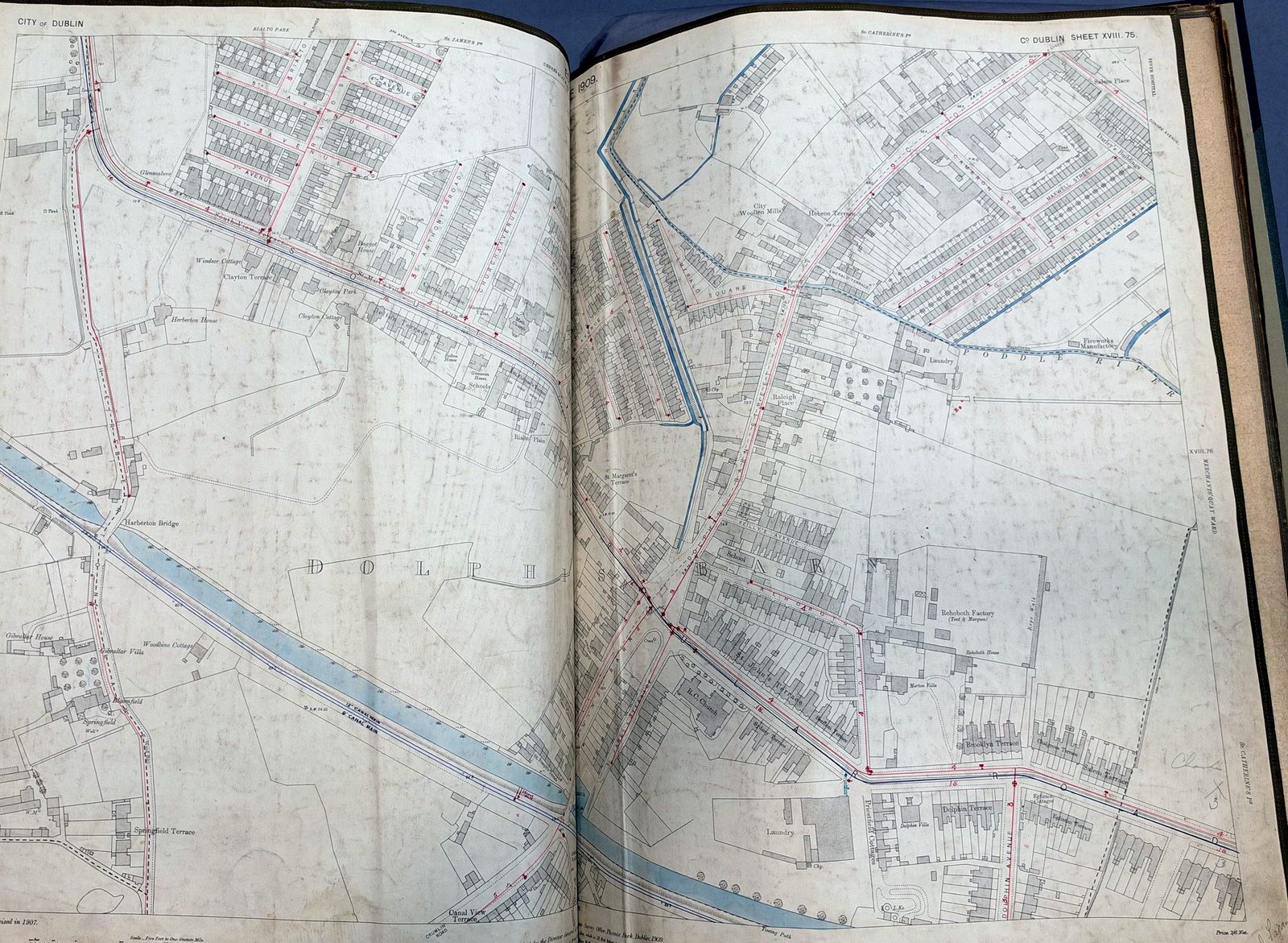
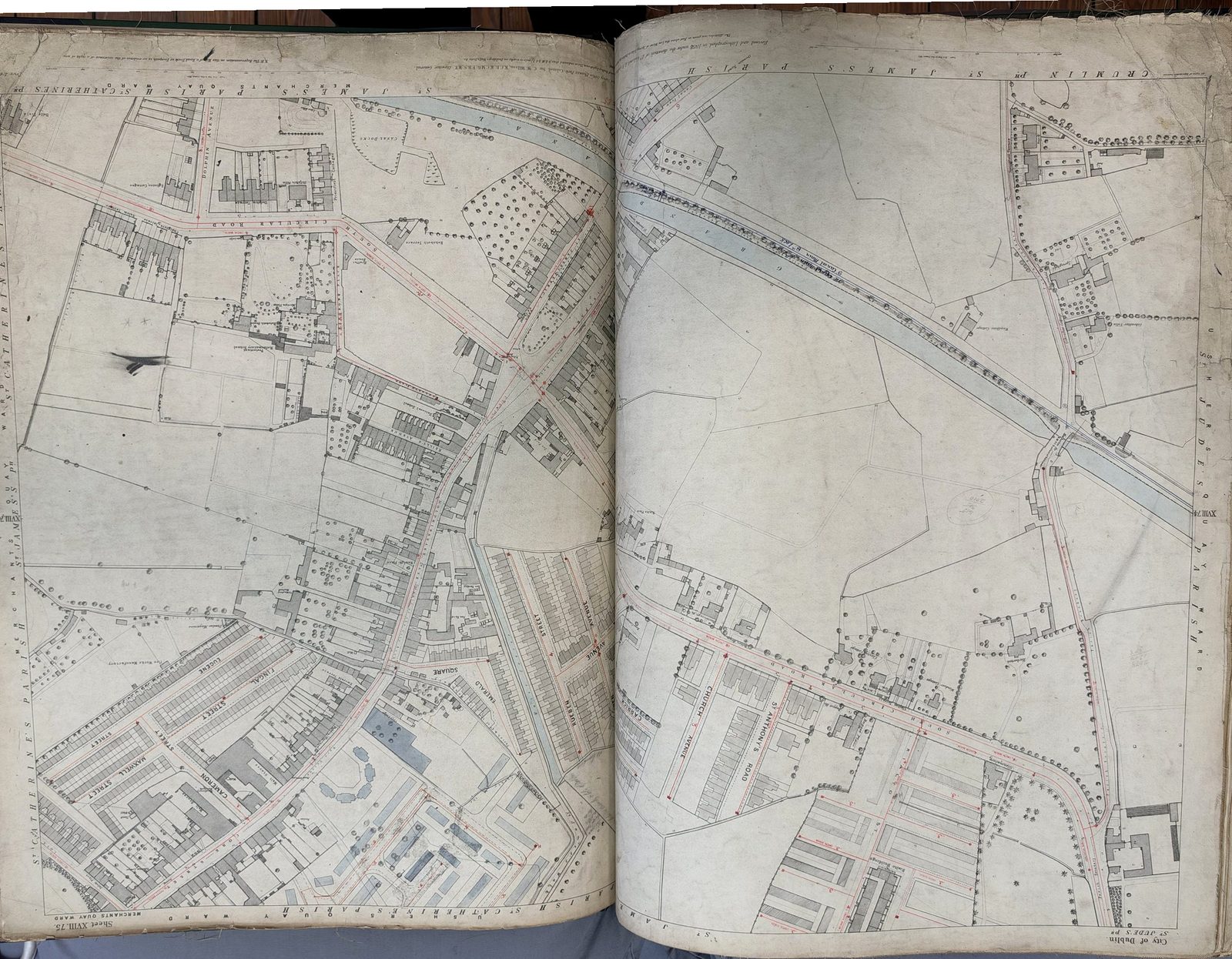
From the Stone Boat the City Watercourse ran north-west, between today’s Mount Jerome and Eamonn Ceannt Park, and along Rutland Avenue to Dolphin’s Barn. Rutland Avenue was once Hall’s Lane, and may have been renamed after the 4th Duke of Rutland, Lord Lieutenant from 1784 until he died at the Viceregal Lodge in 1787.
Rutland flour mill stood on the watercourse here, on the country side of the canal at the end of what George Bernard Shaw called “a rather pretty little village street”. His father, George Carr Shaw, ran it with a partner, George Clibborn, as Clibborn and Shaw, flour and corn merchants, with an office and warehouse at 67 Jervis Street. In 1938 a newspaper found that the pair had borrowed on the mill, its pond and machinery near Hall’s Lane, and that the ruins of “Shaw’s Mill” could still be seen; one Blackpitts resident remembered the playwright from childhood. Shaw himself wrote that neither partner knew anything about flour, so the business “proceeded by its own momentum”: “They did not work the industry: it worked them.”
Rutland Avenue had football too. Jacob’s FC, formed by workers at the Bishop Street biscuit factory, played here, and in 1921 were founder members of the League of Ireland with their neighbours St James’s Gate. Three Jacob’s players were capped for Ireland: Frank Collins, Tommy Dunne and a Crumlin man, Shay Keogh.
Clarke’s tobacco factory
William Clarke and Son, tobacco and snuff makers, began in South Main Street, Cork, in 1830 and moved production to Liverpool by 1870. When the Irish Free State brought in its own customs duties, the firm came back, and in 1923 and 1924 built a factory at 276 to 288 South Circular Road, on what the old maps show as open fields. Beckett and Harrington designed it with R. Earle, chief engineer of Clarke’s parent, the Imperial Tobacco Company: a single-storey works lit by north lights, then an office building on the road in brick with stone dressings. A staff restaurant followed in 1949, and in the 1960s Player Wills added offices.
The Tenter Water, a branch of the City Watercourse, ran by the site. In December 1924 the Dublin Borough Commissioners began a relief scheme, with a £45,000 government grant, to give work to the unemployed. One of its jobs, costing £2,600, was to divert the Poddle into a culvert at Clarke’s new factory, so that its water no longer ran into the sewers or lay stagnant.
Dolphin’s Barn
In the 19th century Dolphin’s Barn was busy with tanneries and mills. In the 1840s tanners such as James O’Neill, Patrick Ledwidge, Peter Byrne and Margaret Jones worked side by side on Dolphin’s Barn Lane, and the city’s records are full of disputes with tanners over what they did to the water. Better-off residents were allowed to supply their poorer neighbours from private fountains, landlords piped water to tenants through pipes no thicker than a goose quill, and near Kimmage and Dolphin’s Barn people cut holes in the banks to water their fields.
The river was dangerous. In August 1877 a child, Eliza McMahon, fell into the Poddle near her home at 20 Rutland Avenue and drowned; the inquest jury asked the Corporation to do something about the state of the river. In September 1931 a boy named Rooney from Rutland Avenue found the body of an infant in it.
In March 1937 a grating above Rutland Cottages choked, where the river went underground for 400 yards before it emptied into the canal near Dolphin’s Barn Bridge. Cottages flooded three feet deep. Mrs McNamara of 5 Rutland Cottages spent the night carrying her children to safety, and in the morning made breakfast standing knee-deep in water.
In January 1938 Dublin Corporation announced 556 flats for 550 families between Dolphin’s Barn Street and Donore Avenue, a £250,000 scheme that meant widening both streets and diverting the part of the Poddle that ran through the site.
The Back of the Pipes
From Dolphin’s Barn the watercourse was carried on a raised bank to the City Basin. The lane along it, between Dolphin’s Barn and James’s Walk, was known as the Back of the Pipes. It ran behind Reuben Street, Fatima Mansions, Mallin Avenue and Lourdes Road, past the “Stone Sofa”, and came out on James’s Walk opposite the old iron footbridge. For generations it was a place for courting couples, and in Dublin slang anything that could not be found was “at the back of the pipes”. Nearby stood the Leinster cinema, later the Dublin Ice Rink. The line of the old canal branch here was filled in and the Luas now runs along it.
In March 1879 the Irish Times reported “a crime of a most fiendish nature”. A woman lured a four-year-old girl from Pill Lane to the Back of the Pipes, stripped her and threw her over a six-foot wall into the Poddle. The river was usually four feet deep and swift, but that day there were only two feet of water; the child stood up and screamed, and a neighbour saved her. Her clothes turned up in a pawn office the next morning.
In 1958 a writer in the Evening Herald recalled that you could still ask at Dolphin’s Barn for the Back of the Pipes and be sent to the lone footpath to the canal bank behind St Kevin’s Hospital, and remembered the iron hand pumps in old city basements that lifted the basin’s low-pressure water to the cisterns upstairs, if you could afford one, and a maid to work it.
Source: Irish Times, 4 March 1879 and 27 November 2020 (Frank McNally); Evening Herald, 2 May 1958.
The City Basin
The first City Basin, a reservoir filled from the watercourse, was made around 1670. Between 1682 and 1721 Dublin’s population roughly doubled, from about 60,000 to 120,000, and in 1721 a new basin was built off James’s Street, between where St James’s Hospital and the Guinness Storehouse are now. It could hold about three months’ supply and served 90 streets. It was later joined to the Grand Canal. In the 18th century it was a fashionable promenade, approached through an ornamental arch at the end of Basin Lane, with walks lined with lime and elm, garden seats, bands, concerts and fireworks.
Next to the basin, the brewery at St James’s Gate had the right to the same water under Arthur Guinness’s lease of 1759, and fought the city for it in 1775: see the meander Guinness and St James’s Gate.
The visitor Richard Twiss was less impressed in 1775: both the springs and the reservoir were dry while he was in Dublin, and of the canal begun from it in 1765 he wrote that “it bids fair for being completed in three or four centuries.”
After the canal line closed in 1974 the basin and harbour were filled in, but the names Basin View and Basin Street remain. In March 2023 Dublin City Council workers regenerating the linear park at Rialto, near the Fatima Luas stop, uncovered part of the old basin.
Source: Betty Brunkard, Basin Street Harbour (Fountain Resource Group, 2014); The Journal, 16 March 2023.
St Thomas’s Abbey
The water ended its journey at the Abbey of St Thomas the Martyr, off today’s Thomas Street. Henry II founded it in 1177 in atonement for the murder of Thomas Becket, and it was the only royal foundation in medieval Ireland. Its liberty, Thomas Court and Donore, controlled the western approach to the walled city, and it grew rich on lands in Meath, Dublin and Wicklow. Henry VIII dissolved it in the 1530s and gave it to William Brabazon, whose family became the Earls of Meath; the Earl of Meath’s Liberty lasted into the 19th century and gave the Liberties their name. Nothing of the abbey stands, but excavations on South Earl Street have found its remains.
Pictures from the archive
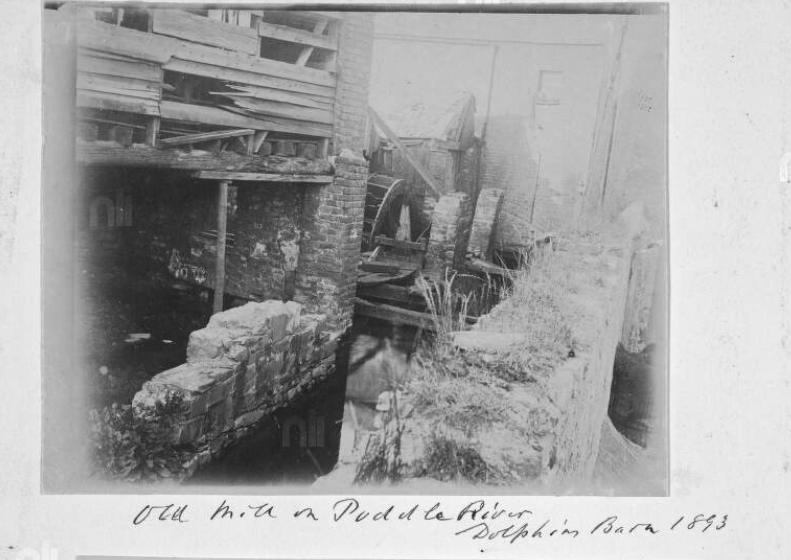
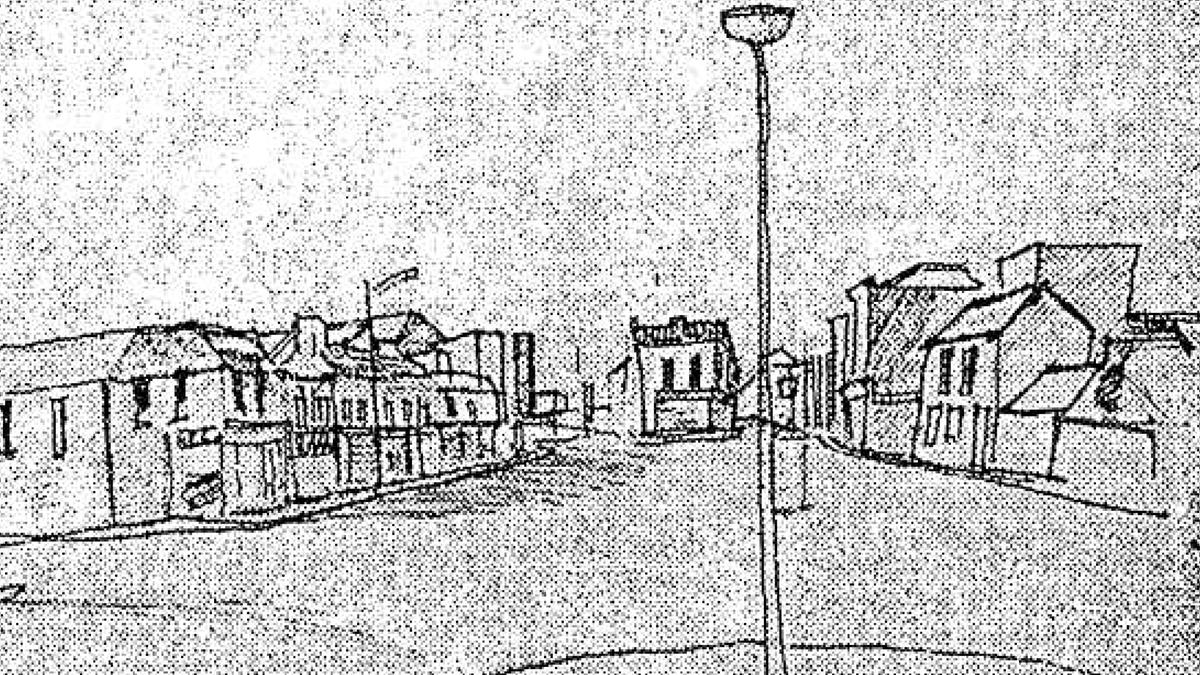
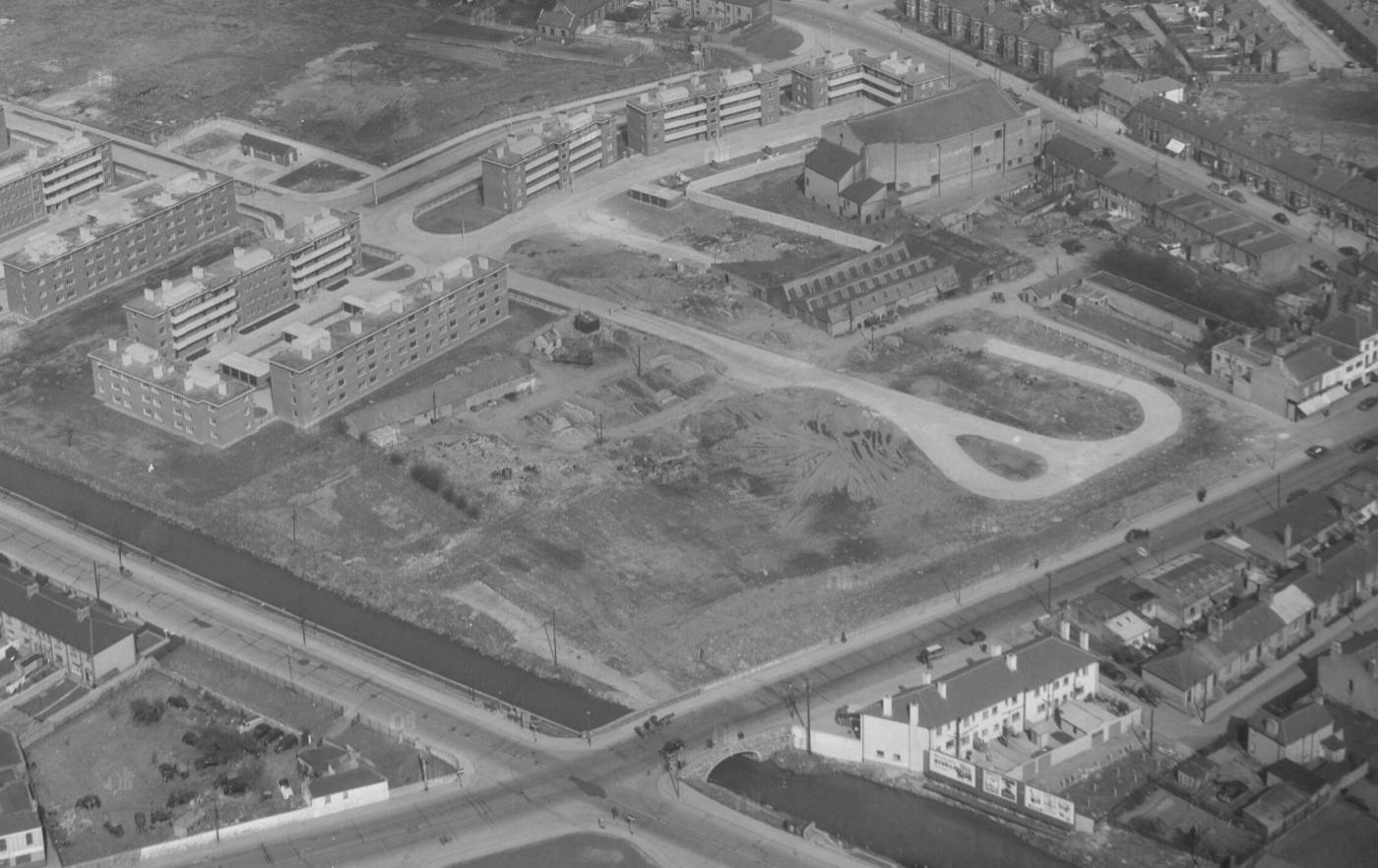
Pictures gathered by the Crumlin and Walkinstown History Group for their Poddle research, shown here in black and white. If you know more about any of them, or hold the rights to one, please get in touch.
Poddle People
- Arthur Guinness: Brewed with the City Watercourse
- George Carr Shaw: The playwright’s father, a reluctant miller
Parts of this page draw on research by the volunteers of the Crumlin and Walkinstown History Group, shared with poddle.ie. About their research.