Meander · off Stop 13, Cross Poddle
The Liberties
The old manors outside the walls, their weavers and the Poddle Guard.
Why “the Liberties”
The Liberties take their name from the manors outside the city walls that kept their own courts after the Normans came: the archbishop’s Liberty of St Sepulchre, and the Liberty of Thomas Court and Donore belonging to St Thomas’s Abbey. Between them they ran from the Liffey to St Patrick’s. Huguenot weavers made the area famous for cloth in the 17th and 18th centuries, but trade laws and changing markets brought decline, and by the 19th century it was a place of tenements.
The Poddle and its branches run all through it. The main river comes from Blackpitts behind New Row and Clanbrassil Street, through Cross Poddle and down Patrick Street. The City Watercourse ran down the middle of Thomas Street from James’s Street towards Christ Church. The Commons Water runs behind Cork Street and the Coombe to St Patrick’s, and the Abbey Stream through Marrowbone Lane, Ardee Street and Mill Street.
The Poddle Guard and the City Sword
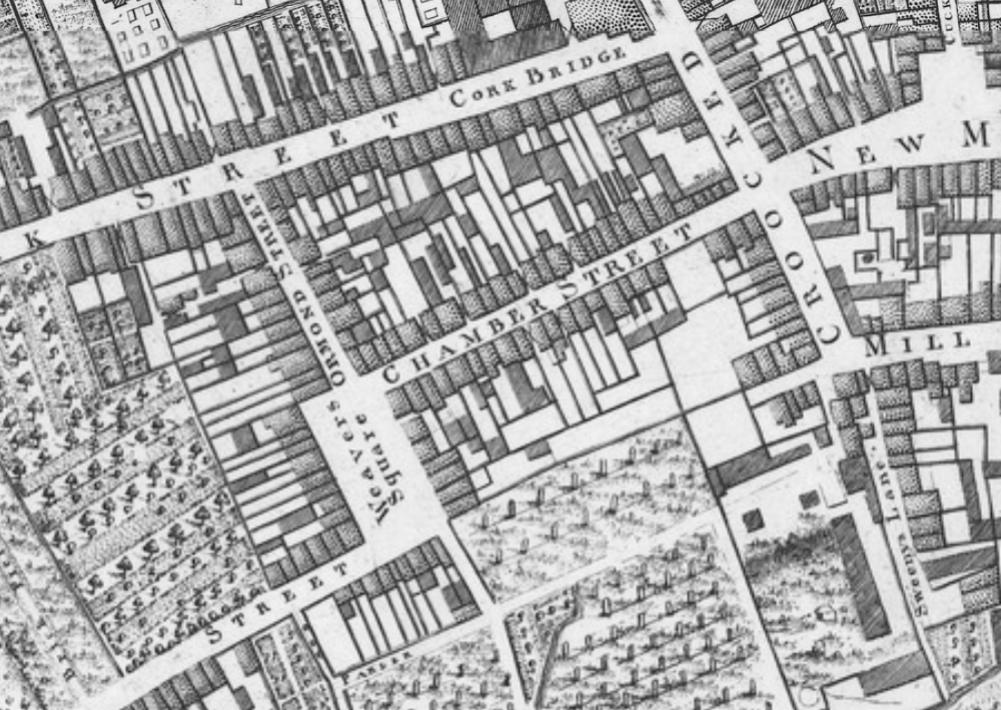
The Liberties kept their own peace, with the help of the Poddle Guard. On 4 August 1752, when the Lord Mayor and city officials rode the bounds of the Liberties, some mischief-makers at the Poddle snatched the ceremonial City Sword. The Poddle Guard caught the thief, who was sent to Newgate. In the same year, when the Liberty Boys heard that English cloth was being got ready for sale in Chamber Street and Weaver’s Square, they turned out in force and took more than ten pieces, burning or tearing five or six before the Poddle Guard broke them up.
According to Rev. Myles Ronan, the Dodder and Poddle together brought the old city an average of 613,200 gallons a day, and after turning the mills the water served the dyers of the Liberties.
Weaver’s Square
Weaver’s Square and Ormond Street, off Cork Street, recall the Huguenot weavers who came in large numbers in the late 1600s at the invitation of the Duke of Ormond. Newmarket, laid out by the Earl of Meath in the 1670s, was their trading place. Weaving here is much older: digs in the Liberties have found Hiberno-Norse spindle whorls, weights and bone needles. The Weavers’ Hall on the Coombe, with its statue of George II holding the tools of the trade, is long gone, but its picture is kept in Dublin City Library and Archive. When the trade declined, the weavers turned to upholstery, lace and later motoring scarves and bow ties.
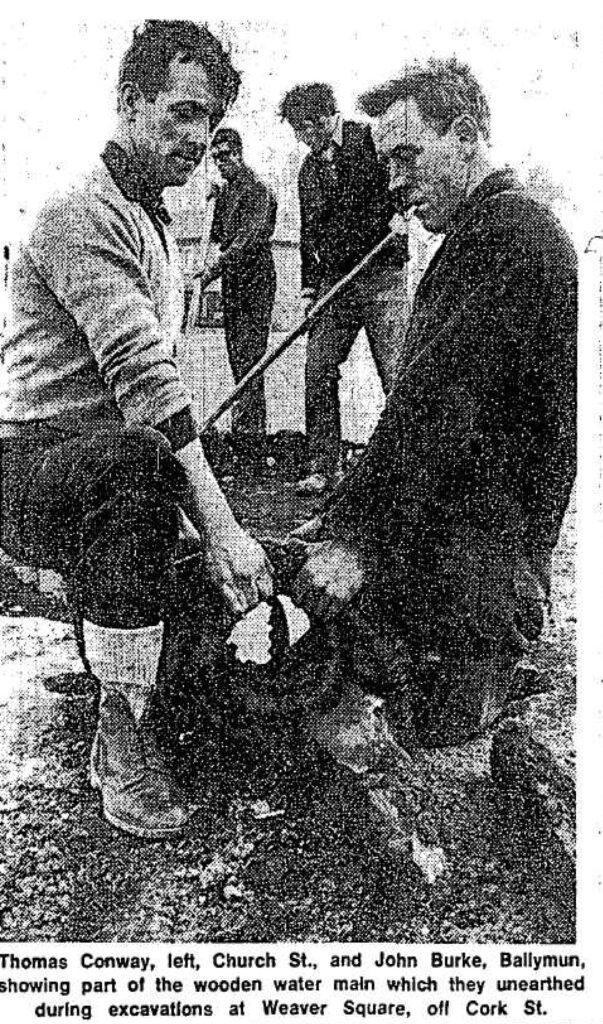
The river did not run through the square, but its water did. In the early 1970s Corporation workmen laying new pipes found seven feet of oak water pipe, about seven inches across and with steel joints, five feet down. Thought to be about 250 years old, they were larger than any found in the city before. The workmen were Tommy Conway, John Burke, Peter Foran and Paddy Dunne.
Crosstick Alley
Crosstick Alley, in the Liberty of St Thomas, ran from Francis Street to Meath Street. A 1971 article suggested its name came from a forgotten shrine or a crossing on the Poddle, but no map shows the river anywhere near it.
Pictures from the archive
Pictures gathered by the Crumlin and Walkinstown History Group for their Poddle research, shown here in black and white. If you know more about any of them, or hold the rights to one, please get in touch.
Poddle People
- Jonathan Swift: Dean of St Patrick’s, on the river’s island
Parts of this page draw on research by the volunteers of the Crumlin and Walkinstown History Group, shared with poddle.ie. About their research.